Before the Byline: How News Desks Took Shape
News desks shaped how reports reached readers. Learn to read selection, editing, timing, and page placement without assuming more than the evidence allows.
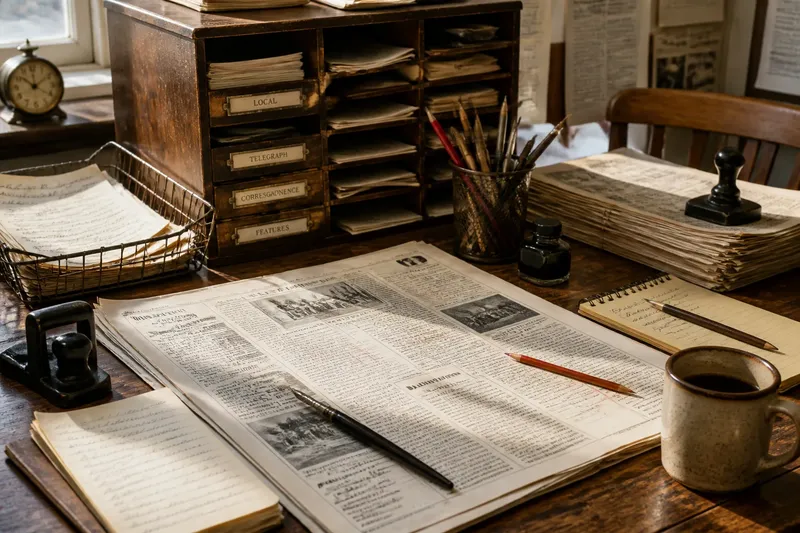
The common mistake is to treat an old newspaper as a stack of reports printed just as their writers submitted them. That can obscure the choices behind each edition—and lead readers to mistake a finished page for an unfiltered record. News desks helped publications coordinate incoming material, editing, and production, though the work did not begin with one invention or develop in the same way everywhere.
Surviving newspapers make those decisions easier to discuss than to reconstruct: a printed page shows what appeared, not every exchange behind it. The most careful account, then, stays close to what the page can support and treats the broader history as a gradual, uneven development.
Editors coordinate copy
In a small publication, an editor might gather material, write, correct copy, and prepare pages for printing. As a publication handled more contributors and subjects, coordinating those tasks became harder. Editors had to decide what belonged in an issue, what needed clarification, and what might have to wait.
This was not simply a change in job title. It made selection and arrangement visible parts of editorial work. A report could describe an event accurately and still be left out because the publication had limited room, a deadline, or other priorities. The existence of an editorial choice does not, by itself, tell us its motive.
For a particular newspaper, claims about how its staff worked should rest on evidence such as surviving issues, internal records, or reliable accounts of its operation. Without that evidence, it is safer to describe what the edition displays than to assign a specific process to its editors.
Contributors feed the center
Publications could receive material from correspondents and other contributors beyond their immediate neighborhoods. An editor then had to fit submissions into a publication’s available space and style. The contributor supplied an account; the editorial center decided how, whether, and when it would appear.
That process did not make the contributor irrelevant. Someone present at an event might provide observations unavailable to an editor elsewhere. But the submitted account could be shortened, clarified, paired with other material, or held while a detail was checked. A printed story should not automatically be treated as the contributor’s untouched wording.
Say a local paper receives two accounts of a town meeting: one from an attendee and another from a reader who heard about it later. The editor gives the attendee’s account more space, marks an uncertain detail for follow-up, and holds the second submission rather than presenting it as confirmation. The resulting page offers an observable distinction between a first-hand account and an unverified retelling; it does not reveal every discussion that led to the decision.
Editing takes several hands
When several people handled copy, a report’s published form could reflect more than one editorial decision. One person might revise for clarity and length, another prepare a headline, and someone else arrange the page. The division of work could vary, so a reader should not assume the same roles at every publication.
Editing could make a paper more consistent: names and spellings could be regularized, long submissions shortened, and different writers’ material presented in a shared style. But consistency is not completeness. Compression can remove a qualification, while a headline can emphasize one aspect of a report over another.
That does not mean every edit distorts a story. A concise revision may make a tangled account easier to follow. When a report seems unusually certain or tidy, ask what its wording establishes and what it leaves out, rather than assuming either that it is untouched or that it has been deliberately altered.
Page space shapes emphasis
A printed newspaper had finite room. Editors and production staff had to fit reports into columns and pages, so length and placement were practical concerns as well as editorial ones. A report might be shortened, moved, or held for another issue; a late submission might miss the edition.
Placement can show that a publication chose to feature a report in that issue. It cannot, on its own, establish why editors chose that position or what they thought about every detail. The surrounding stories and available space are part of the page’s context, but they do not expose the full reasoning behind it.
For readers, the useful distinction is between an observable choice and an inferred motive. You can point to a story’s position or length. You need further evidence before claiming that the placement proves a particular intention.
Deadlines divide accounts
Publication schedules tied reporting to production. Material had to arrive and be prepared in time for an issue, so editors faced a choice between publishing what was ready, waiting for more information, or leaving a report out. A later edition could carry added context or a correction; an earlier one might preserve an account made before those details were available.
When comparing editions, note their publication dates or times where available, any update or correction notice, and the specific changes in the text. Those clues help distinguish a developing account from a later one. A changed report is evidence that its published form changed—not, by itself, evidence of bad faith.
What can the page show?
Did news desks replace reporters?
No. Reporters and correspondents continued to gather and write accounts, while editorial staff coordinated how material entered an issue. The division of work varied between publications and over time.
Why might an editor cut a report?
Limited space and production schedules could require shorter copy, and an editor might also revise wording for clarity. The printed version alone may not show which reason applied in a particular instance.
Does placement reveal a motive?
Placement shows where a publication chose to put a report. To establish why, a reader needs evidence beyond position, such as an editorial statement or relevant records.
What does a byline establish?
A byline names a writer when the publication supplies one. It does not identify everyone who edited, checked, or arranged the finished report.
Read the evidence closely
The history of news desks is best approached as a gradual and uneven shift toward coordinating contributors, editorial work, page space, and deadlines. For any specific paper, distinguish what surviving pages show from what would require additional evidence about its staff or routines.
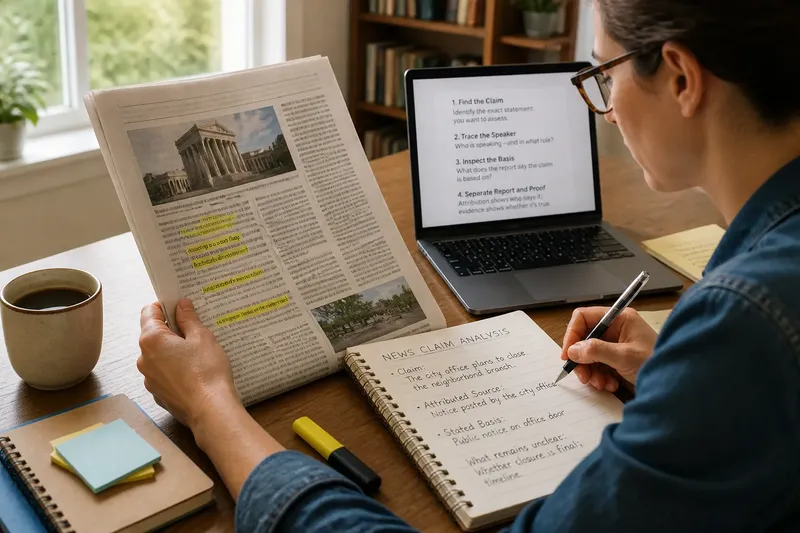
When reading an old newspaper, note the byline, length, position, nearby items, and any edition or correction details. These features help explain how the report reached readers, while leaving room for an honest limit: the page records the editorial result, not every choice that produced it.